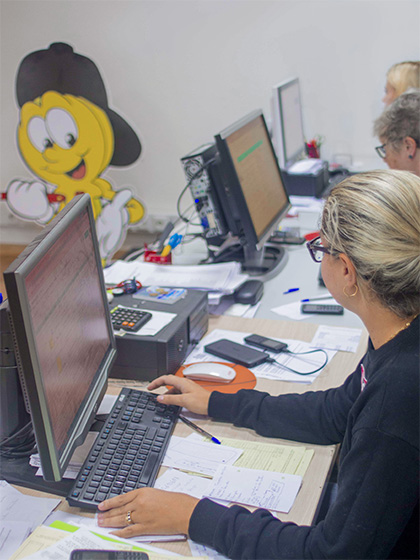
We do the opposite. SOS Multiassistência has run its own leak detection team across Greater Lisbon since 1995, and our job is to pinpoint the source before anything is opened, so the repair that follows is small and precise. We use non-invasive methods — acoustic listening, thermal imaging and moisture meters — to detect a leak without breaking walls or lifting your entire floor. Our team of 37 technicians works 24/7, 365 days a year, everything stays in-house with no subcontracting, and we speak English throughout. Whether it is your own flat, a villa, a shop or a building you manage, we can survey the property, tell you exactly where the water is escaping, and put it right. If you suspect a leak — an unexplained bill, a growing damp patch, the sound of running water in a quiet room — call 211 304 186 or message us on WhatsApp on 911 791 640, and we will arrange a visit and give you a clear quote before starting.
How our water leak detection works without breaking walls
Our approach is non-invasive: the aim is to find where the water is escaping without opening the property at random. To do that we combine several instruments and choose the right one for each type of leak and each pipe material.
Acoustic listening with a ground microphone amplifies the sound water makes as it escapes a pressurised pipe. By moving the sensor across the surface, the technician finds the exact spot where that sound is loudest. On longer or buried runs, we use acoustic correlation, which picks up the noise at two points along the pipe and works out the distance to the leak from the tiny difference in timing.
Tracer gas is one of the most reliable methods for the awkward cases. We introduce a harmless gas into the emptied pipe; being lighter than air, it rises through the leak point and is picked up at the surface by a sensor. That lets us locate leaks under concrete floors or buried in the ground without digging up the whole area.
A thermal imaging camera reads temperature differences in a wall or floor: a hot-water leak warms the surrounding surface, a cold one cools it, and the thermal image shows that trail. Once we have found the source, a moisture meter reads the damp in the material and maps how far the water has already spread through the wall or floor, so we know the real extent of the patch before we open anything. Where it helps, a pressure test isolates the affected section so we can confirm the leak and which circuit it sits on. It is this cross-checking of methods that lets us mark the source to the centimetre, instead of chipping away at the wall on a hunch.
Signs you have a water leak
A leak usually gives itself away long before the water appears in the open, and the clearest sign is a bill that jumps with no explanation. If your usage has suddenly risen and nothing has changed in the household, there is very likely water escaping somewhere in the system.
Other tell-tale signs include a damp patch that appears and grows on a wall, ceiling or skirting; a drop in pressure at the tap or shower; and the sound of running water inside the wall when the flat is silent. When it is the hot-water pipe that has failed, a section of floor or wall often feels noticeably warm to the touch, because the heated water escaping the network warms the material around it. You may also notice a musty smell or patches of mould where nothing was damp before.
If you recognise one or more of these, do not wait for it to settle on its own, because it will not: a small leak tends to worsen and damage more of the structure. It is worth booking the detection early, while the damage is still contained.
One important distinction: a leak is a loss of water from the pressurised network — the pipes, joints and meter. That is different from damp that gets in from outside through walls, roofs or joints. If your problem is water penetrating from the outside rather than escaping from a pipe, that is a different survey, and our leak detection is for the pressurised-network cases.
Three simple ways to detect a leak at home
Before you call us, there are three quick checks you can run yourself to work out whether you really have a leak. None of them needs any special kit — no moisture meter, no leak detector — and each one tells you something about a different part of the system.
The meter test is the most direct. Turn off every tap and appliance that uses water and note the reading on your meter. For an hour, use no water at all — and do not flush the toilet — then check again. If the figures have moved, water is running somewhere it should not be.
The tank test is for anyone with a storage tank at home. Close the water supply to the tank, mark the level it sits at, and come back after a while. If the level has dropped with nobody using water, there is a loss somewhere in the network.
The cistern test finds leaks in the toilet itself. Put a few drops of food colouring into the cistern and wait without flushing. If the colour appears in the bowl, the cistern is letting water through. If any of these tests comes back positive, call 211 304 186 and we will pinpoint the leak precisely.
Our process, quote and repair
We built our process to take the surprise out of the cost, which is the number one complaint from people who have used this service elsewhere. Here is how it runs.
First, the booking: you call 211 304 186 or message us on WhatsApp on 911 791 640, describe the signs you have noticed, and we arrange a visit at a time that suits you. On longer or buried runs we may ask a few questions in advance so the technician arrives with the right instruments.
Second, the survey and quote: the technician runs the detection on site, cross-checks the methods above, and marks the source precisely. Before any repair begins, you get a clear quote for the work, so there is no surprise at the end — the figure we agree is the figure on the invoice, and you decide with the full cost in front of you.
Third, the repair: because we have pinpointed the leak, the opening is small and targeted rather than a wall torn open on a guess. Our own team carries out the repair, reinstates what was opened, and leaves the area clean. Everything stays in-house from detection to finish, so one team owns the job from start to end.
To book a survey, call 211 304 186 or message us on WhatsApp on 911 791 640, and we will arrange a visit and give you a clear quote before any work starts.